
WEX Fuel Cards Explained: How the Program Works
What a WEX fuel card does, what data it captures, and what changes when it is issued through a fleet platform instead of a standalone portal.

If you run a fleet, you have probably encountered WEX. It is one of the largest fuel card issuers in North America, and a great many commercial fleets carry its cards.
What is less well understood is what actually happens around the card — what data each swipe generates, what controls sit behind it, and why the same card can be a reporting headache in one setup and a genuinely useful data source in another.
This article explains how the program works. A note on who is writing it: EKOS is an integration partner that issues WEX cards inside its fleet platform. We are not WEX. For current card terms, fees, and application requirements, WEX is the authority — what follows is about how the card behaves once it is in a driver's hand.
01 What a fuel card actually is
A fleet fuel card is a payment credential with rules attached. The payment part is the least interesting half.
What separates a fuel card from a corporate credit card is that the transaction carries fuel-specific data and passes through fuel-specific controls. The merchant terminal knows it is a fleet card, prompts for additional information, and reports back more than an amount.
02 What each transaction captures
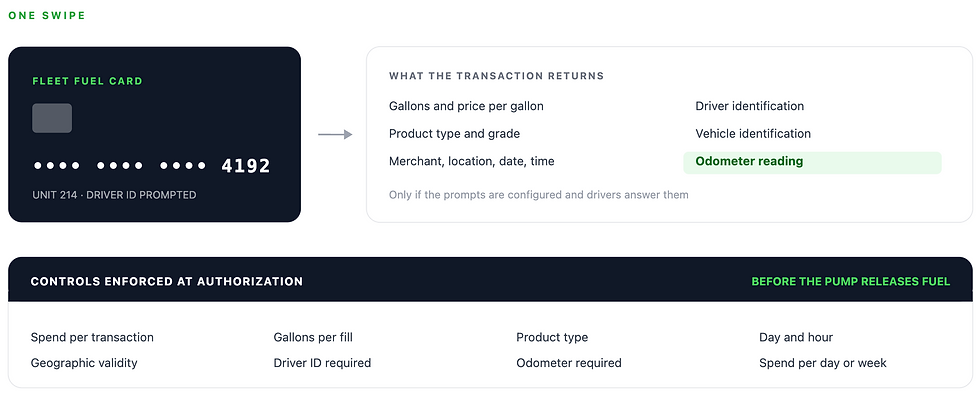
A well-configured fuel card transaction returns considerably more than a dollar figure:
Gallons purchased and price per gallon, not just the total
Product type — which grade, and whether it was fuel or merchandise
Merchant, location, date, and time
Driver identification, where a driver ID or PIN is prompted
Vehicle identification, where the card is assigned to an asset
Odometer reading, where the terminal prompts for it
That last one is the quiet workhorse. An odometer captured at every fill is a continuous mileage feed, and mileage is what turns fuel spend into cost per mile and triggers maintenance schedules. Fleets that capture odometer at the pump stop chasing it anywhere else.

03 The controls behind the card
Controls are enforced at authorization, before the pump releases fuel. That is the mechanism that separates a fuel card from an expense policy — an expense policy is enforced afterward, by someone reading receipts.
Typical control dimensions include how much can be spent per transaction, per day, or per week; how many gallons per fill; what products can be bought; which days and hours the card works; where geographically it is valid; and whether a driver ID or odometer must be entered before authorization.
Set too loose, controls do nothing. Set too tight, drivers get declined at a pump at eleven at night and you get a phone call. The workable approach is generally to set limits generously enough that legitimate fueling never fails, and rely on exception reporting rather than hard declines to catch the rest.
04 Where acceptance matters
A card is only useful where it works. Acceptance is the practical constraint that decides whether drivers actually use the program or quietly pay out of pocket and expense it — which destroys the data you bought the card for.
The EKOS WEX program states acceptance at more than 95% of US fuel locations. Before committing, the test worth running is narrower than a national figure: take the stations your drivers actually use on their actual routes and check those. A network that covers 95% of locations nationally can still miss the two truck stops your night shift depends on.
05 What changes when the card sits inside a fleet platform
This is the part that distinguishes setups, and it is where most of the practical difference lives.
In a standalone arrangement, the card program is its own system. You log into a card portal to issue and control cards, download transaction reports, and then reconcile those reports against your fleet records somewhere else — usually a spreadsheet, usually monthly, usually by someone who dreads it.
When the card is issued through a fleet platform, the transaction lands directly against the vehicle. Fuel cost posts to the asset record. The odometer from the pump updates the vehicle's mileage, which advances maintenance schedules. Cost per mile recalculates without anyone assembling it. And retail purchases sit alongside private site fueling in the same reporting.

None of that is impossible with a standalone card and enough spreadsheet work. It just does not happen reliably, because it depends on someone doing a monthly reconciliation that has no deadline attached.
06 What the card program costs
Fuel card economics vary by issuer, program, fleet size, and credit profile, and current terms should come from the issuer rather than from an article. The categories to ask about are consistent though: transaction or per-gallon fees, monthly account or per-card fees, billing cycle length and payment terms, late fees, and any rebate or discount structure.
The comparison that matters is net. A program with a monthly fee and a meaningful rebate can cost less than a free one, and a headline rebate means little without knowing what it is paid on and what conditions attach.
07 Where EKOS fits
EKOS issues WEX cards inside its fleet platform, which means card management, transaction data, vehicle records, maintenance, and private site fueling live in one system rather than being reconciled between two.
EKOS also pays a 1% rebate on qualifying fuel spend, monthly, for fleets enrolled in the EKOS Fleet Module. That condition is worth stating plainly rather than discovering later — the rebate is tied to platform enrollment, not to the card alone. Transaction-level reporting sits in fuel card analytics.
Frequently Asked Questions
What is a WEX fuel card?
A WEX fuel card is a commercial fleet payment card issued by WEX, one of the largest fuel card providers in North America. Beyond payment, it captures fuel-specific transaction data — gallons, price per gallon, product type, and often driver ID and odometer — and enforces purchasing controls at the point of authorization.
What data does a fuel card transaction capture?
Gallons and price per gallon rather than just a total, product type, merchant and location, date and time, and where prompts are configured, driver identification and odometer reading. The odometer capture is particularly valuable because it feeds mileage-based maintenance scheduling and cost per mile.
Can fuel card controls stop a purchase before it happens?
Yes. Controls are enforced at authorization, before fuel is dispensed — limits on amount, gallons, product type, time of day, and location. That is the difference between a fuel card and an expense policy, which is only enforced after the fact by someone reviewing receipts.
What changes when a fuel card is managed inside a fleet platform?
Transactions post directly against the vehicle rather than arriving as a separate report to reconcile. Fuel cost attaches to the asset, pump odometer readings advance maintenance schedules, cost per mile updates automatically, and retail purchases appear alongside private site fueling.
THE BOTTOM LINE
EKOS issues WEX cards inside the platform that already runs your vehicles.
Every swipe posts to the right asset, with a 1% rebate on qualifying fuel spend for Fleet Module customers.

WEX CARDS INSIDE EKOS
Every swipe posts to the right asset.
EKOS issues WEX cards inside the platform that already runs your vehicles, with a 1% rebate on qualifying fuel spend for Fleet Module customers. See the fuel card program


