
WEX Fleet Cards: What to Know Before Enrolling
Nine things worth checking before you sign up for a fleet card program — acceptance on your routes, control granularity, data depth, and what a rebate is actually paid on.

Most fuel card decisions are made on two numbers: the rebate and the fee. Both matter and neither is where the program succeeds or fails.
What determines whether a card program is worth having eighteen months in is whether drivers use it everywhere, whether the data arrives complete, and whether anyone is actually looking at it. Those are knowable in advance if you ask.
Nine things worth checking before enrolling — in any program, including this one.
01 Acceptance on your routes, not nationally
National acceptance figures are true and not very useful. What matters is the stations your drivers currently use.
Pull three months of fuel purchases, list the locations by frequency, and check the top twenty against the network. If your night shift depends on two truck stops that are not covered, drivers will pay personally and expense it, and you will have bought a card program that generates partial data.
02 What the card does at your own fuel sites
If you operate private fueling, ask whether the same card authorizes there. Two credentials for one driver is an administrative cost and a data split — retail transactions in one system, private fueling in another, and a manual join to see total fuel spend per vehicle.
03 Control granularity
Ask specifically what can be controlled and at what level. Per-transaction and per-day limits are universal. Product restrictions, gallon caps, time and day windows, geographic limits, and mandatory driver or odometer prompts vary more than you would expect.
Then ask what happens when a control is hit — a hard decline at the pump, or an authorization with an exception flagged. Both are legitimate; you should know which you are buying.
04 Whether odometer capture actually works
An odometer prompt is standard. Whether the number is usable is a different question.

05 What the rebate is paid on
Rebates are quoted as percentages or cents per gallon, and the qualifier does the work.
All fuel spend, or only at specific networks
Fuel only, or the whole transaction
Whether a volume threshold applies
Whether it is capped
How often it pays
What conditions attach to eligibility
The EKOS programme pays 1% on qualifying fuel spend, monthly, and requires enrolment in the EKOS Fleet Module. That condition is real and worth weighing rather than discovering afterward — though for most fleets the arithmetic still lands favorably, because fuel spend typically runs many times software spend.
06 Billing cycle and payment terms
Cycle length and payment terms affect working capital more than most fleets account for. A weekly cycle with short terms is a materially different cash position from a monthly cycle. Ask about late fee structure too — fuel card late fees can be steep relative to the balance.
07 What integration actually means
Nearly every card programme claims integration. The versions differ enormously.
A scheduled file export that someone imports is integration. A live sync that posts each transaction to the right vehicle with odometer and cost attached is also integration. The first requires a person in the loop every week; the second does not.
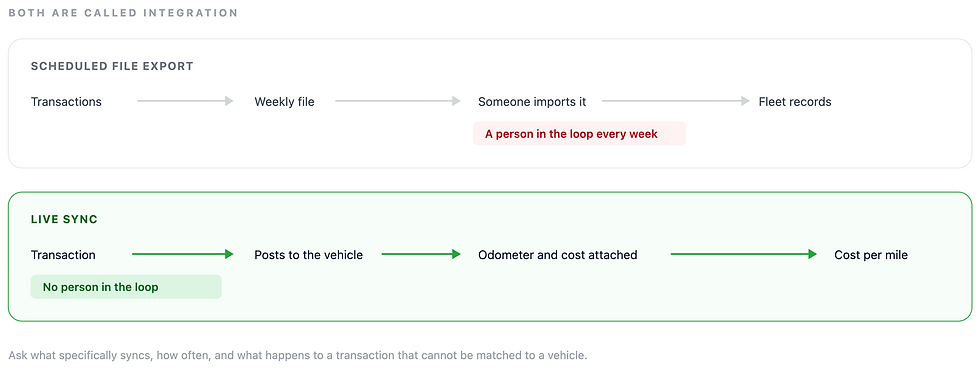
Ask what specifically syncs, how often, and what happens to a transaction that cannot be matched to a vehicle.
08 Card lifecycle administration
Cards get lost, damaged, and handed to new drivers constantly. Ask how long a replacement takes to arrive, whether you can lock a card instantly yourself rather than phoning support, whether cards are assigned to drivers or vehicles or both, and what happens to a card when someone leaves.
The EKOS program states five to seven days from sign-up to cards in hand, with free replacement of existing cards during transition.
08 Who reads the exception reports
This is the question that determines whether any of the above matters, and it is about you rather than the vendor.
A card program generates exceptions — purchases outside hours, gallons exceeding tank capacity, non-fuel items, out-of-area transactions. If nobody owns reviewing them, the program is a payment method with extra steps.
Before enrolling, decide who reviews exceptions, how often, and what they do about one. Fleets that answer this get value from any competent card program. Fleets that do not get value from none of them.
09 What switching involves
Transition is usually simpler than expected — new cards issued, old ones cancelled on a cutover date, drivers briefed. The parts that need planning are the overlap window so nobody is stranded, historical data export from the outgoing program before access ends, and updating any automated payment or accounting setup.

10 Where EKOS fits
EKOS issues WEX cards inside the fleet platform, so the integration question answers itself — transactions post to vehicles natively rather than arriving as a file. Cards can be issued, replaced, locked, and cancelled from the same place you manage the vehicles they belong to, and assigned to drivers, vehicles, or departments to match how your organization actually runs. More on card management and the wider fuel card program.
Frequently Asked Questions
What should I check before enrolling in a fleet fuel card program?
Acceptance at the specific stations your drivers use rather than the national figure, whether the card works at your own fuel sites, control granularity and what happens when a limit is hit, whether odometer capture is validated, what the rebate is actually paid on, billing terms, what integration means in practice, card lifecycle administration, and who will review exception reports.
How do I evaluate a fuel card rebate?
Ask what it is paid on — all fuel spend or only at specific networks, fuel only or the whole transaction — whether a volume threshold or cap applies, how often it pays, and what eligibility conditions attach. A headline percentage means little without those qualifiers.
How long does switching fuel card programs take?
The mechanics are usually straightforward: new cards issued, old ones cancelled at a cutover, drivers briefed. Plan an overlap window so nobody is stranded, and export your historical transaction data before the old account closes, because that access generally ends with the account.
Does a fuel card work at private fuel sites?
It depends on the program. Some fleet cards authorize only at retail locations, which means drivers carry a second credential for company fueling and your fuel data splits across two systems. Worth confirming before enrolling if you operate your own sites.
THE BOTTOM LINE
EKOS issues WEX cards from the same platform that manages your vehicles, drivers, and private fuel sites.
One card, one roster, one set of reports.

WEX CARDS INSIDE EKOS
One card, one roster, one set of reports.
EKOS issues WEX cards from the same platform that manages your vehicles, drivers, and private fuel sites.


